UNION NEWS
 Date : Monday, 3rd March 2014
Josephine Minoo joins Nairobi University in 2014 to study medicine. She wishes to specialize in neuro surgery. Congrats Josephine.

A solar powered pump was constructed in 2010 to pump water from a 160 meter borehole to 7 greenhouses and 5 fish ponds.

Tomatoes and chillies are harvested and sold at local markets to help finance the education of orphans from primary through to secondary, technical and university level. 
Tilapia are fed on algae generated from chicken manure from the nearby chicken house with supplementary fish feed supplied by ministry of agriculture extension agents.
A cow shed and goat shed were constructed in 2011 and the animals manure mixed with water produces methane gas for cooking and lighting in the nearby polytechnic kitchen.

Processing methane gas from cattle manure for cooking
A small circular brick building was completed in 2010 in which oyster mushrooms are grown.  Â
Â
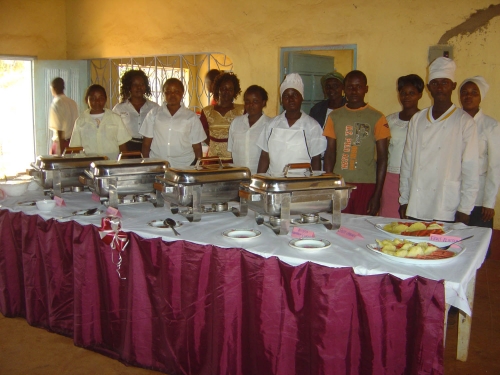
In 2012 the Ministry of Youth Affairs took over the management of the polytechnic and a Food Technology and Catering Course was added to the curriculum.
Food Science & Beverage Class
A residence for girls was completed in 2013 which can accommodate up to 100 boarders.
It is planned to expand the production of fruit trees such as mangos, avocados, papaya and indigenous trees in the tree nursery to supplement food needs & promote afforestation.Â
The polytechnic now provides training to the local people in carpentry, masonry, tailoring, computer science, motor mechanics, welding and Food Science & Catering.
Fr. John Mahon Manager Kwakakulu Orphan Care Project with orphaned youth taken November 6th 2013
Â